Legislators prepare for World Urban Forum (WUF13)
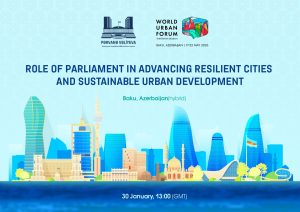
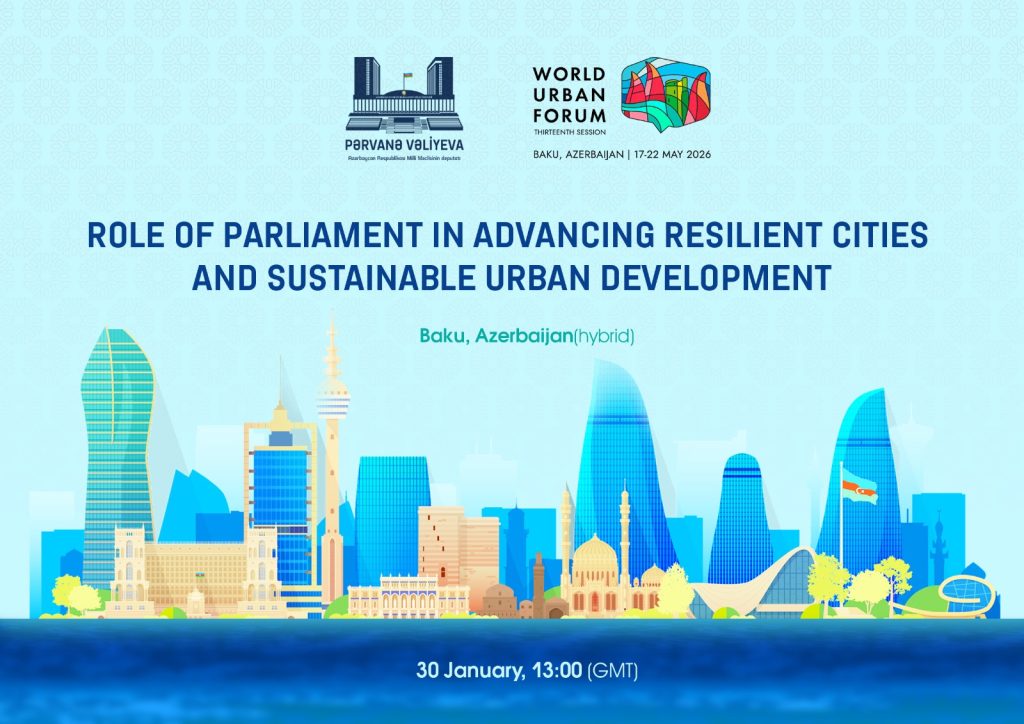
On 30 January 2026, more than 30 Members of Parliament gathered online to discuss the role of legislatures in advancing sustainable urban development and to highlight the importance of the upcoming 13th Session of the World Urban Forum (WUF13) in Baku. Hosted by the Milli Majlis, the parliament of the Republic of Azerbaijan, the webinar brought together parliamentarians and leading figures from UN Habitat, UNDP and other institutions to discuss parliamentary support for the New Urban Agenda and the SDGs. The webinar marks the start of a process for parliamentary engagement at the WUF13 in Baku from 17-22 May 2026.
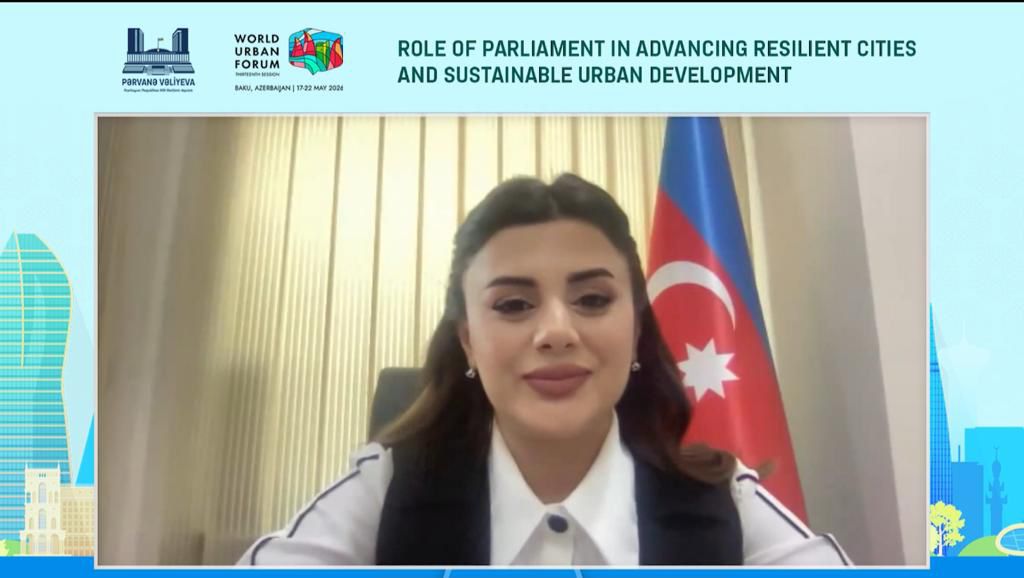
GLOBE is proud to support this effort and bring it to the attention of the wider parliamentary constituency. We are pleased to share a Blog below by Parvana Valiyeva, Member of the Foreign and Interparliamentary Relations Committee, Milli Majlis of the Republic of Azerbaijan, who hosted the January webinar. The webinar can be viewed at: https://youtu.be/41SEvPfIoE0?si=gVB84cgeMYBrIB7c
Cities, People, and the Future of Urban Development
In today’s global landscape, geopolitical tensions are rising, and cities are increasingly exposed to conflict-related risks, environmental threats, and hybrid challenges, including attacks on critical infrastructure. Yet cities are far more than physical spaces.
Cities are people. They preserve history, shape national identity, and serve as centers of social cohesion, culture, and economic life. Protecting cities therefore means protecting communities, human dignity, and collective memory. In this sense, sustainable urban development is no longer only about growth or infrastructure — it has become a matter of resilience, peace, and security.
More than half of the world’s population now lives in cities, and this number continues to grow. Today, six out of every ten people live in urban areas. This rapid urbanization should serve as a wake-up call for the global community. It forces us to rethink how cities should develop in the future.
However, the current reality presents serious challenges. Nearly three billion people worldwide live in inadequate housing conditions. Another 1.1 billion people reside in informal settlements or temporary shelters, while more than 300 million people are completely homeless. These conditions create profound health, safety, and economic challenges for societies across the globe.
Housing is one of the most fundamental human rights. Everyone deserves to live in a city where they are not simply surviving but truly thriving. Yet achieving this goal requires collective action. No single country or institution can solve the global housing crisis alone.
This is where multilateral cooperation becomes essential. Governments, international organizations, private sector actors, and civil society all have a role to play — and something to gain. As Albert Einstein famously said: “We cannot solve our problems with the same level of thinking that created them.” Addressing urban challenges requires new ideas, new approaches, and new forms of cooperation.
The World Urban Forum: A Global Platform for Urban Solutions
In this context, the World Urban Forum (WUF) plays a vital role. As the United Nations’ largest global platform dedicated to sustainable urban development, it brings together governments, mayors, experts, NGOs, youth representatives, and private sector leaders.
The Forum provides a space where stakeholders can discuss how cities should evolve and how the global housing crisis can be addressed collectively.
More than just a conference, it is a high-level platform for debate, cooperation, and policy innovation, focusing on the most pressing challenges and opportunities facing cities today.
Azerbaijan will host the 13th Session of the World Urban Forum (WUF13) together with UN-Habitat from 17 to 22 May 2026. The theme of the Forum will be “Housing the World: Safe and Resilient Cities and Communities.”
The event will bring together heads of state, government officials, city leaders, researchers, practitioners, and innovators to address the global housing crisis.
The program will include strategic dialogues, partner-driven events, interactive sessions, an international urban exhibition. The goal of WUF13 is to elevate housing as a top global policy priority, showcase practical solutions from around the world, and mobilize new commitments in financing, policy, and partnerships. The Forum is expected to produce several key outcomes, including the WUF13 Perspectives, the official report, and a forward-looking “Baku Call to Action.”
Azerbaijan’s Urban Transformation
Azerbaijan enters this process not only as a host country but also as a country actively implementing sustainable urban development principles. Today, Azerbaijan is a peaceful and rapidly developing nation with significant experience in organizing major international events. One of the most compelling examples of the country’s urban development vision can be seen in the post-conflict regions of Karabakh and Eastern Zangezur. These regions are being reconstructed under the national program known as the “Great Return.”
The reconstruction process includes ambitious sustainability goals. These territories are expected to become some of the world’s first net-zero carbon emission zones by 2030. Azerbaijan’s urban transformation extends far beyond post-conflict territories. Modern urban planning initiatives in Baku, new transport and infrastructure projects across the regions, the creation of ecological parks, and the construction of socially oriented residential complexes all reflect the country’s commitment to shaping a sustainable urban future.
A Historic Moment for the Forum
WUF13 will also mark a historic milestone. For the first time in the Forum’s history, a Leaders’ Summit will be held as part of the program. Heads of state and government from UN member countries will gather to exchange views on housing challenges, urban resilience, and sustainable development. This summit will create an unprecedented platform for high-level dialogue on the future of cities.
Participants from around the world will attend the Forum, including research institutions, think tanks, civil society organizations, private sector representatives, international experts. The Forum will also serve as an important platform for the Global South and developing countries, ensuring their perspectives and challenges are heard in global discussions about urban development.
From Discussion to Action
The main ambition of the Baku Forum is to move the global conversation from discussion to action. This will be achieved by presenting practical solutions, strengthening political and financial commitments, and adopting concrete outcomes through the Baku Call to Action. By encouraging global cooperation, sharing best practices, and generating new knowledge, WUF13 aims to make a meaningful contribution to the future of sustainable urbanization.
Urban development is ultimately about people. It is about giving every individual the opportunity to live safely, with dignity, in resilient and vibrant communities. In Baku, the world will come together to advance this shared goal.
The Role of Parliaments in Urban Development
Against this backdrop, parliamentarians play a crucial role in translating global commitments into national legislation and policies that strengthen urban resilience and promote people-centered development. Parliaments are uniquely positioned to transform international agreements — such as the New Urban Agenda and the Sustainable Development Goals — into national laws, budgets, and accountability mechanisms. They help ensure that housing is treated not merely as infrastructure but as a fundamental human right, central to social stability, public health, and economic resilience.
On 30 January, a dedicated meeting with 32 Members of Parliaments of 30 countries was held to discuss the role of legislatures in advancing sustainable urban development and to highlight the importance of the upcoming 13th Session of the World Urban Forum (WUF13) in Baku.
The meeting brought together parliamentarians to exchange views on how national legislatures can contribute to addressing urban challenges, particularly the global housing crisis and the need for resilient and inclusive cities. Participants discussed how parliaments can support the implementation of international commitments, including the New Urban Agenda and the Sustainable Development Goals, by translating them into effective national policies and legislation.
As preparations for WUF13 continue, such dialogues with lawmakers help strengthen the link between global discussions and national action — ensuring that the outcomes of the Forum translate into meaningful progress for cities and communities.
Cities Must Serve People. It is about the daily lives of constituents: access to safe housing, reliable infrastructure, clean environments, and resilient communities capable of withstanding economic, environmental, and social challenges. By connecting global commitments with the practical needs of their constituencies, MPs can help ensure that cities evolve in ways that prioritize people’s well-being and dignity.
Parvana Valiyeva
Member of the Foreign and Interparliamentary Relations Committee
Milli Majlis of the Republic of Azerbaijan