*Translated from the original Portugese by GLOBE. Published in Brazil’s O GLOBO paper and Valor Economico
Rio Climate Action Week seeks to mobilize society and resources to implement climate laws and actions
— Daniela Canedo- Rio de Janeiro
Around the world, National Congresses play a crucial role in overcoming climate challenges. To advance the transition toward a low-carbon economy and climate resilience, countries need parliamentarians who create laws and oversee their implementation. In Brazil, the approval of the new environmental licensing law on the eve of COP30 shows that environmentalists are underrepresented in the midst of the climate crisis, hindering the fulfillment of international commitments. Laws such as the creation of the carbon market, however, pave the way for the development of mechanisms to reduce CO2 emissions.
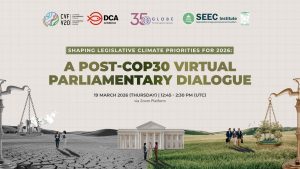
The legislative branch’s contribution to combating the climate crisis and other topics, such as innovation and sustainability, will be discussed at Rio Climate Action Week, which takes place from August 23rd to 29th. Rio Climate Action Week is a side event of the COP that brings together civil society representatives. It is inspired by London Climate Week, which first took place in London in 2019 and has since traveled to cities in countries hosting COPs. The goal is to support the COP30 presidency, revitalize multilateralism, and mobilize funding to scale up climate action.
“Legal certainty is essential to attract international investors, without which there is no energy transition or sustainable development,” says Malini Mehra, co-organizer of the first edition of the event in Rio.
Malini also serves as CEO of GLOBE Legislators, a nonpartisan organization founded by prominent lawmakers such as Al Gore and John Kerry. Fifteen years ago, the organization began annually tallying climate laws and policies worldwide, allowing for comparisons between countries. Malini believes a collective effort and a focus on implementation are essential.
Over the past ten years, there has been an exponential increase in climate laws and policies, now totaling over five thousand. This number is more than one hundred times the 54 laws and policies that Globe estimated in its first survey, at COP3 in Kyoto in 1997.
International example
The United Kingdom was the first to establish the Climate Change Act in 2008, and today has robust, legally binding laws with clear monitoring and penalty mechanisms. Focused on the legislature rather than the executive, the English legislation is considered a model, as it avoids discontinuing climate policy with each change of government. The English Parliament has created comprehensive legislation, a carbon budget that undergoes five-yearly reviews to prevent setbacks, and an independent scientific committee that presents annual reports to Parliament.
A Globe survey commissioned by O GLOBO highlights 12 laws around the world considered crucial for combating the climate crisis in their respective countries (see sidebar). These include legislation supporting the energy transition, such as the U.S. Inflation Reduction Act—despite its name, it focuses on billion-dollar investments in clean energy projects—and regulations for the carbon market, as in Brazil.
Of those 12 countries, four are African: South Africa, Kenya, Uganda, and Zambia. According to Malini, despite its vulnerability, Africa has a relatively young infrastructure and enormous potential for renewable energy generation, but only receives about 2% of the investments made, for example, in solar energy. Hence the importance of clear rules and the creation of funds to promote this type of energy:
— Investors are looking for certainty, policy coherence, and commitment from governments. In Africa, parliamentarians have been very proactive.
In Brazil, according to the director of the Institute for the Right to a Green Planet (IDPV), Danielle de Andrade Moreira, the National Climate Change Policy dates back to 2009 and naturally needs to be adapted to the new context. However, given the recent approval of the new licensing law, this would not be the ideal time to try to update it.
“We’re seeing a movement in the Executive branch to draft a new bill that’s more aligned with the Paris Agreement. While this is very welcome, if we take the discussion on a new climate policy to Congress today, which is very conservative, there’s a high chance we’ll face massive setbacks,” he says.
According to Danielle, the 63 presidential vetoes to the licensing law were important, but reestablishing three-phase licensing (with the sequence of preliminary, installation, and operating licenses) for strategic projects with a term of only one year is unfeasible due to the complexity of the process and the depletion of environmental agencies.
“Furthermore, the law exempts the agricultural sector, which alone is responsible for 28% of greenhouse gas emissions, from licensing, and the president did not veto this” he emphasizes.
Danielle points out that the 2024 law that established the regulated carbon market also explicitly excludes the agricultural sector from the regulated market’s obligations. Considering emissions from deforestation and forest degradation linked to agriculture, this means that up to 75% of Brazilian emissions could, in practice, be excluded from the scope of the regulated carbon market.
Concrete actions
Within the COP30 framework, interparliamentary discussions are on the agenda, according to Congressman Nilto Tatto (Workers’ Party-SP), coordinator of the Environmental Parliamentary Front, who participated in the 2nd Parliamentary Summit on Climate Change and Just Transition in Latin America and the Caribbean earlier this month. The summit culminated in a letter to the COP30 presidency in which parliamentarians recognize that “the role of legislators in tackling the climate crisis is essential to transforming international commitments and goals into concrete, legitimate, and sustainable actions, through laws and regulations at the national and subnational levels.”
However, says Tatto, at the national level, there are difficulties regarding the composition of the Houses themselves.
— There’s a kind of denialism related to science or climate change when bills like the environmental licensing bill, or others, are approved that don’t align with what the whole world sees: that the agenda for tackling the climate crisis, in Brazil’s case, is an agenda of opportunity, given all of Brazil’s natural resources.

More like this:
COP side event in Rio discusses the role of Parliaments
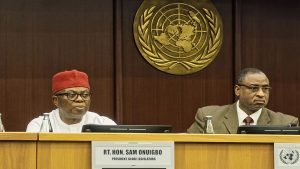
GLOBE Pre-COP Parliamentary Forum, 27 August 2025, Rio Legislative Chamber